25 March 2015

the beauty of mermaid's purses


it's a day of diffused sun filtering through a whitish haze - surprisingly bright as the foghorns have been sounding and the shore in the distance is barely discernible. boats are reduced to cut outs - simple flat shapes collaged against the even paler grey of the coast against the even paler hue of the sky. it is as if the day has been formed from nothing more than card in varying gradations of grey and a pair of scissors.

but down at my feet things are clearer. the equinox spring tide is receding fast and amongst the dark coppery kelp the milky white and palest celadon of the mermaid's purses are breaking the surface of the water. there are large numbers anchored in twos and threes bound tightly to the holdfasts of seaweed. their tendrils are spun round and round in a big tangled spiral suspending them securely against the rushing tides.


freshly laid mermaid's purse - nursehound (scyliorhinus stellaris) - on the red list

visible yolk and embryo of the small-spotted catshark (scyliorhinus canicula)

nursehound case with orange star ascidian colony (botryllus schlosseri)


most of this season's eggs have been laid alongside those whose hatchlings have long gone. empty inside but the tough keratin walls of the exterior are encrusted with a whole host of new life. each old egg case supports a miniature world looking like a tiny abstract painting. intense bursts of colour sing against a dark ground. a particularly beautiful one is bejewelled with star ascidian - two types of  botryllus schlosseri - on one side a translucent yellow with rust-tipped petals and on the other a deep aubergine with pale yellow centres.


i could spend hours here just looking, looking and looking some more. lost in unbroken awe and wonder i haven't noticed the time or anything around me. i feel bewitched, mesmerised and filled with wonder. the water lapping at the top of my wellies has come too soon. the tide has turned. there is so much more i'd like to see but the water is flooding in fast. i will have to wait until another day, to see them properly that will be another month.

i tread a reluctant retreat and carry my feelings of new found wonder higher up the beach. as i trace the high tide line there are many dried mermaid's purses shrunken and wrinkled amongst the heaps of crispy weed. most are old. but i'm alarmed to find a few that are fresh with yolks clearly visible attached to holdfasts broken free.

i gather them together and wrap them in layers of wet seaweed, fill a bag with water and tie them in another bag. i've no idea if they are alive. there are slits in the tendrils which allow water to flow through the egg case but i don't know how frequently this has to happen. one has a large tear across the centre and i fold back the flap and peek inside. i can just make out a tiny embryo attached to the yolk. sadly it has died. i cut it open to have a closer look.


the embryo usually takes 9-11 months to hatch

it hatches when it is 16cm long, can grow up to 1.6 m and lives for at least 19 years


i empty my water bottle, refill it from the sea and head home with a seeping bag which drips persistently down my leg.

i have kept the egg cases in a box of sea water in the garden overnight. the following day i fit the lid firmly in place and head out with strong twine and scissors. today the spring tide is not so low. it has to be a quick trip and although the tide has turned i'm able to take them out a reasonable distance and tie them amongst others. i have to be fast. i position them at the foot of a distinct rock so i can find them again. the wind is chilly and my hands are cold. i see a beautiful stripy case and a ribbon of seaweed covered in star ascidian before i have to leave. the day has clouded over and light rain begins to fall.


24 March 2015

spring equinox - hidden sun


freya catches the eclipse - photo christopher laughton - check out freya laughton' s blog 


friday
picnic breakfasts with flasks of coffee
gaggles of children marching along the seafront with colanders on their heads
air thick with collective expectation and anticipation
excited chatter and smiles
clock watching and sky gazing
the light gradually dimming
silvery grey over the horizon
waiting and waiting, shivering in a swimsuit
take the plunge and swim out, out to sea
eery atmosphere as if a storm is brewing
subtle shifts, subtle colours, calm and quiet
all is quiet at sea
nothing but the day
a girl in a dress paddles up to her knees
the fabric bunched up around her waist
she wants more
she throws her dress to a man on the shore
and swims out in bra and knickers

an eclipse to begin the day and later
gin and elderflower with rosemary
seedlings bursting forth from bottles hanging in a window
down a dark alleyway a hidden house
red wine and large chunks of milk chocolate
a line of skulls along the mantlepiece
black and white photographs of things i love
9 heart urchins from ireland

saturday
the sharpening of chisels
the quiet concentration of 10 people cutting dovetails
spalted sycamore with knots and whorls
later, people of penryn unite with music and laughter
reclaim the roads and dance in the streets
fresh lemonade and an array of cakes
children shower a folk singer with cut grass
a reservoir beckons in the low sun
a bride marries an ancient oak
daylight fades
evening coffee in cafe with black ink drawings
ideas and new plans

sunday
run and sea swim
low equinox tide
kayakers riding the gentle surf
the beach stretches longer than i've known
unusual creatures are revealed
a baby sea hare mottled with deep red
a wentletrap slides sideways
starfish in unbelievably tiny cracks
layers of iridescent seaweed half dry
stretched taught between rocks catch the warm spring sun


close up of a spiny starfish (marthasterias glacialis)
spiny starfish hiding
 bold arctic cowrie (trivia arctica) that kept me amused by
swinging it's trunk-like siphon at me
on a journey past a hermit crab
baby sea hare (aplysia punctuate)
common grey sea slug (aeolidia papillosa)
common brittle star (ophiothrix fragilis)
tiny stars on a 7 armed starfish - in this case a 6
and a half armed starfish (luidia ciliaris)


iridescent seaweed drying in the sun


shining silver and ultramarine violet
ahhh - she always catches me.....

28 February 2015

ghost ships


after a thin sliver of a new moon
cradled bright within a perfect faint circle of light
bold stars of the sky dancing in formal constellations
grey rain-veiled day -  the blurred vision of peering through muslin
a wide expanse of watery sand laid bare by the low spring tide
not a soul
the tiniest heart urchin salt and sand-filled bobbing in a shallow pool
the same tiny urchin buried safe inside a hard crusted bread roll
no lunch - hungry
shy stars of the sea revealed in the gloom
star ascidian and small plump cushion stars
starfish orange and starfish purple scattered
large spiny starfish hidden in the tightest crevice
awkwardly crannied crabs wave a claw in warning
cowies and bowed down kelp
wet legs - wet camera
ghost ships
up on rosemullion two rain washed people
ghost friend
 

20 January 2015

gifts from the january sea


cuttlefish, by-the-wind sailors, mermaid's purses and mussel shells

crinkly edge of nursehound egg case


fresh from the sea - beautiful colours

love the greeny greys


same egg case - three stages of drying

the sky through a dried by-the-wind sailor skeleton

my friend found an oyster in a mussel shell!

07 January 2015

by-the-wind sailors arrive on new years day

the year has started here in cornwall with tens of thousands of tiny sailed vessels floating in to our shores. beaches from sennen to longrock to poldu and many on the north coast have been covered in stranded by-the-wind sailors (velella velella - a pelagic hydroid).


found at longrock bay january 1st - photo by elaine brennan


these amazing little creatures (which are actually not a single organism but a colony of hydroids) live on the open ocean. they have either a left handed or a right handed diagonal sail which determines which side of the wind they travel. it is made of chitin which is the same type of material as insect wings. most that wash up on cornish shores have a sail that twists to the left.


probably some of the same fleet at trenow cove 4th jan


i love the deep indigo blue of their jellyfish-like base. they use these blue pigments to screen themselves from the sun's radiation. their predators include sea slugs and violet sea snails (janthina janthina) which are born male and develop into females over time.


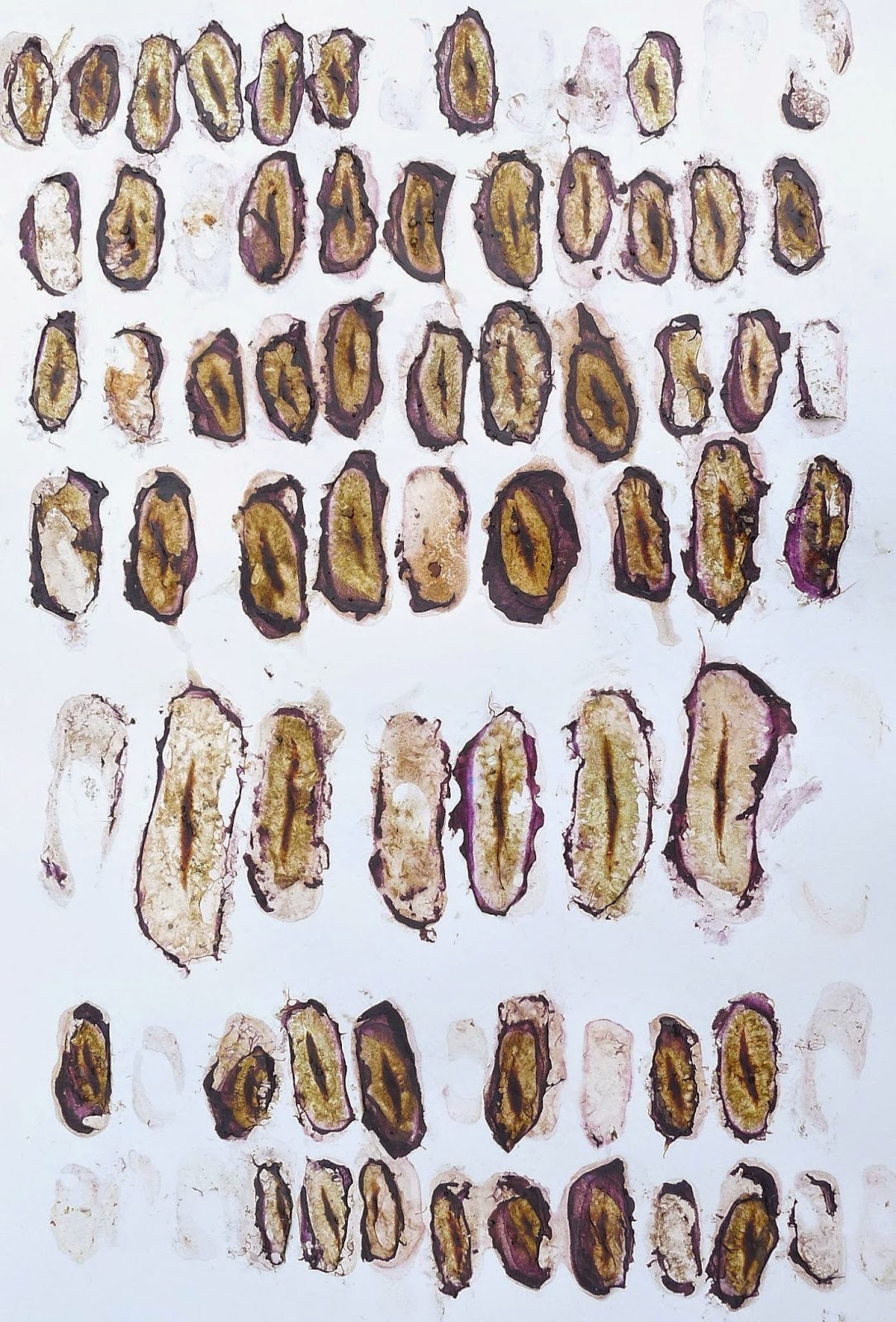
a couple of years ago i had an idea for a piece of work i wanted to make using the dried skeletons. these become opaque and papery as they shrink and dry. i've still not been in the right place at the right time to find more than a few handfuls but gradually i will collect enough to work with.


i was hoping it might be possible to extract the blue pigment but like other experiments i've done drying jellyfish it just turns into a dark smelly sticky mess and the pigment turns brown. some do keep a purpley hue when dried whole.


so i laid them out in rows and as they began to dry i undressed them to remove their skeleton. 


this was so much fun that it was virtually impossible to leave the house to go to something i really wanted to go to. when i returned home i eagerly continued until midnight.


once they are dry there is a beautiful veined texture like a finger print. and their de-hydrated skins also leave their mark upon the paper.


for further information about velella velalla there is a nice little youtube film - 'the secret life of the velella: adrift with the by-the-wind sailor" here.


15 November 2014

outside the box


the lorry stops in the road calling the traffic to a halt. a massive steel arm cranks upwards and outwards. it swings across to the pavement and a giant crab claw lowers a huge white woven bag to the ground. half a tonne of lime mortar has arrived.

i'm re-pointing my wall. hours and hours of digging and scraping with increasingly smaller and sharper implements has whiled away many days. it's felt like something between giant dentistry and cleaning the mud out of a horses hoof - many horses, many times over.

i hammer up bricks and pack nooks and crannies with 'gallets' or 'pinnings'. i ease mortar deep into the gaps until they are flush and filled. 5 hours, one bag of mortar down, at least 20 more bags to go..... it's slow but satisfying. this is something new. i've not done it before. it reminds me of working with soft clay and the tools are similar to those i've used in pottery and sculpture. and i'm mulling thoughts over in my head.

i'm feeling very angry after reading an article where education secretary nicky morgan has warned young people that choosing to study arts subjects could "hold them back for the rest of their lives". coupled with falmouth university's recent decision to close its contemporary crafts BA, art and environment and theatre courses, i'm feeling disillusioned. but i'm also feeling more determined and sure of my future plans.

it's incredibly sad that our education establishments have become big businesses where the drive for profit comes at the expense of learning. initially i thought it was about money. that contemporary crafts was too costly a course to run. that felt disappointing. but i quickly realised that if falmouth university were really concerned about the course, they would be campaigning to save it themselves. so, yes it's about money, but it's also about value and that is more dispiriting.

i could write so much about the value and benefits of craft - the exercising of logic and problem solving; body/brain co-ordination and manual dexterity; the deepening of our connection with ourselves, our past, our heritage and our environment; our vastly disregarded need for aesthetic beauty, spiritual and emotional/mental well being; and yes, in our current system - economical benefit (especially in rural areas like cornwall). and all of this seems to be enormously undervalued, yet i regard it as being of vital importance in a very fundamental human way.

to cut these courses seems incredibly short-sighted. at a time where there are floating islands of plastic choking our marine life, loss of species, habitats, wild places through the exploitation and exhaustion of natural resources, surely 'art and environment' is one of the most forward-thinking, progressive courses? especially being based here in falmouth with it's rich maritime history and natural beauty. and that's just the environmental crisis. looking at social issues with pressure on food and housing for an increasing population - surely many of the skills learnt on crafts courses are transferable creating independence to do such things as repair homes, bake bread etc. why not create courses that are unique to falmouth - that reflect and celebrate cornwall and it's unique heritage and landscape? courses that fulfil a deep human need that is timeless and sustainable - surely that is a better investment?

it seems that to take away such courses (with the potential for other arts subjects to follow) is to take away our self-expression, self-sufficiency, our playful, free-thinking, creative resourcefulness. without this we are numbed and dumbed and easier to subjugate.

when i studied at art college i became involved in running a food co-op as an alternative to supermarkets. i believed (and still do) that big businesses shouldn't control and profit from our basic need for food and survival. i regard making and creating as another primal need and tantamount for the health and survival of our society. never did i think that one day i may see the necessity to set up independent art courses as an alternative to art college.

today my cousin delivers two old wooden boxes to my studio. one is locked. my grandfather died aged 101 in july. as a young child his woodwork shed was my first introduction to tools and making. he built furniture for our bedrooms and he built boats. i feel privileged to have inherited these tools - works of craftsmanship in their own right. i also feel thankful that i know how to use them. i believe that to cut craft education and facilities in schools, colleges and universities severs a vital link to our past and denies us access to our ancestors and our roots.


why did he stick a bovril label on his mallet? i guess we'll never know!


to show your support please sign this petition to campaign against the proposed closure of contemporary crafts at falmouth university - click here

and to join the very active facebook group you can find the link here